Jeff Goins on Writing Rules, Creative Practice and the Value of Mystery
Story by Jeff Goins · 478 readers
Jeff Goins argues that writers need to learn the rules of their craft, then move beyond them through experience, curiosity and trust.
Writing rules can teach a writer how to make a sentence work. They can’t, by themselves, make that sentence matter. Jeff Goins’s case for learning craft and then reaching beyond it begins with a label he doesn’t accept, travels through religion, physics and rock music, and lands on a practical point: mastery asks for more than obedience to convention.
Goins recounts an encounter with an old friend over tacos. After years apart, the friend greeted him as “Jeff Goins, the atheist!” The label came from a Reddit discussion about a podcast Goins had recorded years earlier, which suggested he had moved from writing Christian books to identifying as an atheist. Goins found the misunderstanding funny, and the two went on to talk about faith and mystery.
He doesn’t describe himself as an atheist. To him, the word suggests a certainty about God, the afterlife and existence that he doesn’t possess. Nor does he see a change in someone’s beliefs as proof that they’ve simply swapped one fixed position for its opposite. A person who once spoke confidently as a believer may later question or reinterpret those beliefs without becoming certain that no god exists.
“Agnostic” might fit that uncertainty, Goins writes, but he’s more drawn to “mystic.” The distinction matters to his larger point: he’s interested in what happens when people stop treating certainty as the only measure of seriousness. That question, he argues, has a close counterpart in the arts. Writers can know the conventions of their craft and still recognise that rules are guides, not the experience itself.
Mystery as a way of paying attention
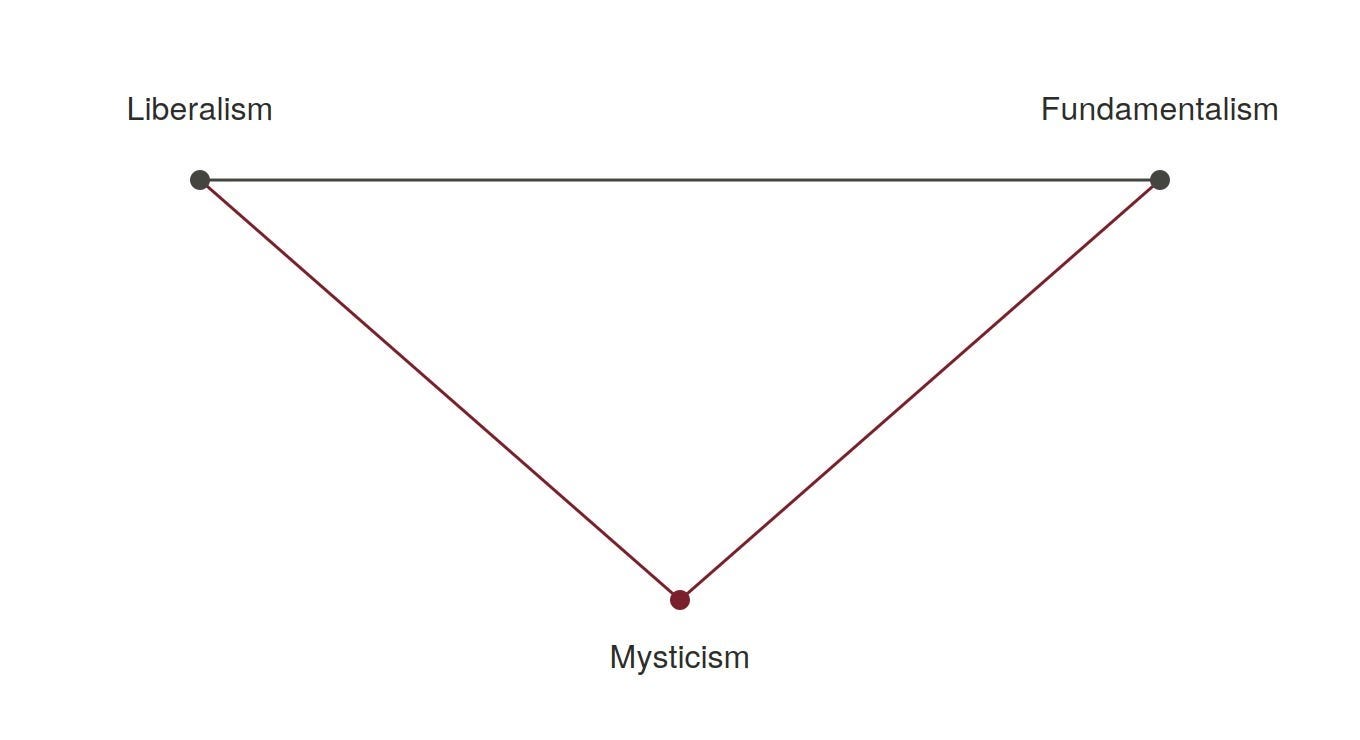
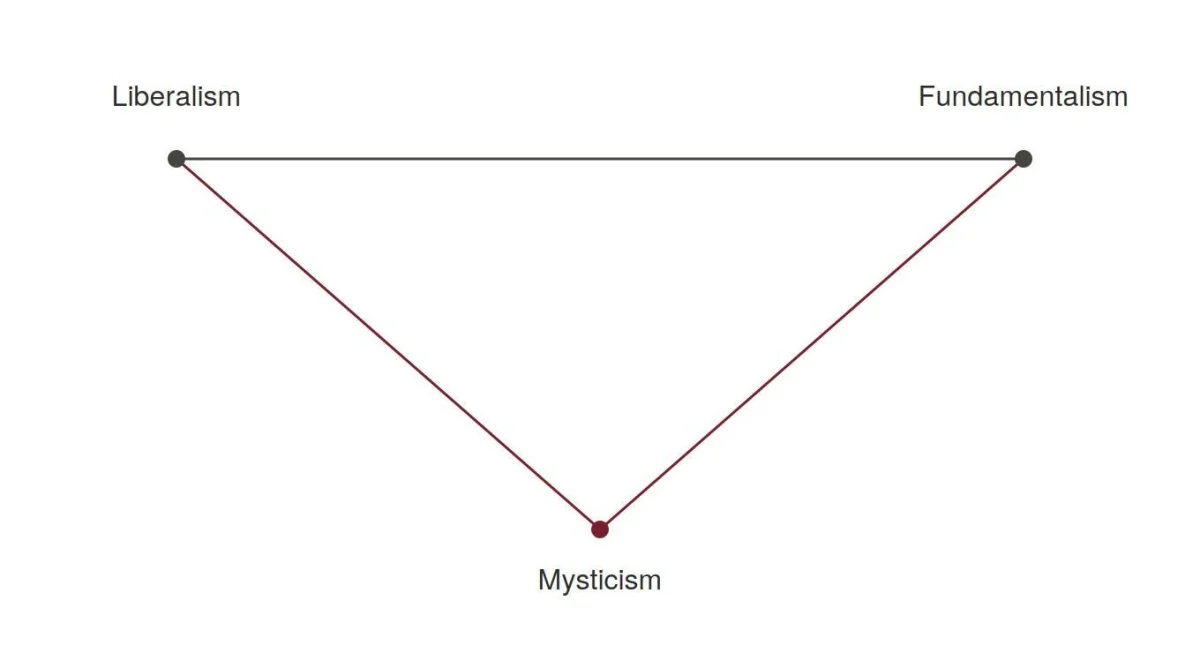
Goins describes mysticism not as a midpoint between rigid belief and dismissal, but as a deeper way of approaching questions that familiar answers no longer settle. Mystics, in his account, aren’t primarily occupied with being right or keeping every religious rule. They seek an experience of reality that can’t be contained by words or doctrine. Some may appear liberal in what they take literally; others may be intensely devoted to their spiritual practice. What connects them is a willingness to live with what they don’t know.
That openness, he suggests, can be misunderstood by people who have spent years trying to follow inherited rules. If the only alternatives seem to be total obedience or total rejection, then uncertainty looks like a failure to choose. Goins proposes another route: rather than simply turning right or left, go deeper. His friend and client Jim Wallis puts the idea this way, in the context of religion and politics: “Don’t go right; don’t go left. Go deeper.”
For Goins, that depth changes a person’s relationship with questions. Continuing to question what seems settled may yield fewer tidy conclusions, but it can also cultivate a different kind of attention. He points readers toward Rumi, Meister Eckhart, Julian of Norwich and Jiddu Krishnamurti, writers and thinkers from distinct traditions who, in his view, turn away from formal structures in pursuit of mystery. Their work can seem both inviting and difficult to follow: it gestures toward qualities such as peace, patience and kindness, while leaving open how those qualities might be lived in ordinary life.
Goins connects this approach to the Buddhist idea of “beginner’s mind”: meeting each situation without assuming that one already understands it. He also invokes Jesus’s instruction to become like a little child, reading it as an invitation to see with fresh eyes rather than through settled expectations. For a writer, the parallel is useful. A beginner’s openness doesn’t mean abandoning what they’ve learned. It means staying receptive to what the work reveals, even when that discovery unsettles an established method.
He brings in physics as another reminder that confident explanations can have limits. Goins says he won’t claim expertise in the subject, but points to readers interested in string theory, quantum gravity, Carlo Rovelli and Ervin Laszlo. At the level of atoms and the wider universe, he writes, familiar ideas about matter, observation and time become difficult to take for granted. His aim isn’t to settle scientific questions; it’s to suggest that inquiry often produces new questions rather than a final account of reality.
In Goins’s framing, that posture resembles the mystic’s: form ideas, test them against experience and remain willing to reconsider them. He contrasts it with the anxious demand to “do it right” or work everything out. People can become caught in the belief that another achievement—a better job, house or relationship—will finally make them feel sufficient. He sees a similar pattern in religious practice when it becomes a promise that enough effort now will secure a reward later.
The mystic, by contrast, suggests that meaning and peace needn’t be postponed. Goins puts the idea in deliberately striking terms: heaven might be available here, now, rather than at the end of a long list of accomplishments. It’s a spiritual claim, but it also prepares his writing argument. A writer can spend so long trying to qualify, master and prepare that the work itself remains out of reach.
From grunge to the edges of musical convention
Goins’s route to writing runs through the music that shaped his ear. He grew up with grunge and the broader alternative sound of bands including Pearl Jam, Soundgarden, Silverchair, Mudhoney, Local H, Weezer, the Pixies and early Radiohead. He remembers the style as a reaction against polished production and the excesses of hair metal: punk’s directness, metal’s weight, and melodies that could reach beyond a narrow audience.
Nirvana stood at the centre of that world for him. As a child of about ten, he carried Nevermind on cassette and listened to it on repeat through a Sony Walkman while walking around his small Midwestern town. When he learned that Kurt Cobain had died, he felt he’d lost not just a musician but a point of connection. Nirvana had given a name, or at least a sound, to a frustration he couldn’t yet explain, and offered the possibility of belonging to a group of listeners who felt similarly out of place.
That first devotion opened into a much larger musical education. Goins moved from Nirvana to the bands that had influenced them, then through classic rock, metal, pop punk, emo and folk. Later came early rock and roll, blues, jazz and big band; now he listens to classical and instrumental music as well as the styles that came before. One artist, he says, led him into a world he’s still exploring.
As a musician, he sometimes hears a piece by Radiohead, Wilco or Miles Davis and wonders how its creator arrived at that sound. The music seems to break rules he had assumed were firm, yet the result works. Goins began with a limited grasp of theory and absorbed his ideas about musical rules largely through radio and the pop and rock he heard as a child. Those songs represented a particular, curated version of what music could be—not the whole field.
His analogy is that music, like religion, has conventions that can give a person a place to start. The deeper someone listens and practises, the more possibilities become audible. A rule that first seemed necessary may prove too narrow; a sound that once seemed impossible may become intelligible through experience. This resembles Goins’s account of inquiry in science and mysticism: closer attention doesn’t always make the world simpler. Sometimes it makes room for more questions.
Goins adds an anecdote about Cobain’s public remarks on music theory. In clips now circulating on YouTube, Cobain says he dislikes theory and doesn’t know terms such as “Dorian modes,” describing himself instead as someone who learned basic chord shapes and played by ear. He also argued that studying too much theory could limit originality.
Goins treats those comments with some caution. Someone who knows nothing about theory wouldn’t necessarily know the names of the things they hadn’t studied, and Cobain had a reputation for presenting himself in ways that didn’t always match his private practice. Whether Cobain consciously studied musical ideas or not, Goins sees the finished work as evidence of a distinctive ability: the songs could be simple in their construction, memorable and catchy, while still making unexpected choices.
Listeners and musicians have since analysed the way Nirvana’s melodies sit over straightforward chord progressions. Goins doesn’t claim to know how much of that effect Cobain planned. He draws a more modest lesson from the contrast between the music and the musician’s account of his method: Cobain reportedly worked at a song, playing it repeatedly until it sounded right. Knowledge of a term or technique isn’t the same as the capacity to make music with it.
Goins compares that instinct to the mystic’s relationship with theology. The mystic may not be focused on the formal vocabulary behind a practice, but can understand its purpose through experience. The distinction, he suggests, is between discussing the music and being able to play it. In art, theory can describe what a work is doing; it can’t substitute for the work itself.
What artists do with rules
Goins turns from music to literature through two writers whose work challenges conventional usage. Cormac McCarthy resisted copy editors over word choice, spelling and grammar. He often used little punctuation, omitted quotation marks around dialogue and brought unfamiliar words into his prose. He also wrote passages in Spanish without translating them. When editors questioned his choices, Goins says, McCarthy could defend them with evidence about a word’s history and reasoning for the form he preferred.
Shakespeare offers a different example. Goins notes that the playwright introduced words that became part of English, citing a quick search that reports more than 1,700 such additions. The point isn’t that artists should break rules for the sake of doing so. It’s that a writer with deep command of language may make choices that eventually change what readers understand as acceptable.
That distinction feels especially pertinent to Goins in an era of AI writing. Fluent, polished language can still be shallow or incoherent. Surface-level correctness doesn’t guarantee that a passage has taken the reader anywhere. He compares that emptiness to ritual without feeling: the outward motions are present, but the purpose has gone missing.
Goins doesn’t argue that art has no rules. Poetry, painting and music all have forms and conventions, and ignoring every one without understanding them can produce work that feels random rather than free. But rules shift. They’re more like a map than the terrain: helpful for orientation, but no replacement for moving through the place itself.
That’s why study alone can’t make a masterpiece, or even guarantee a good piece of writing. A writer needs experience: the uncertain, sometimes laborious act of putting ideas on the page and seeing what they become. Conventions matter most when they help a writer enter a form, learn its possibilities and make deliberate choices. They’re less useful when treated as a complete definition of what the work is allowed to be.
Goins is particularly wary of writing that observes the conventions but never reaches beyond them. In his view, that kind of work can feel lifeless, even when it looks correct. The missing ingredient is not necessarily a clever new technique. It may be the writer’s willingness to go further into the material, to take the questions seriously and find out what the familiar forms can—and cannot—carry.
He sees a related danger in either clinging to conventions without examining them or discarding them simply to suit a personal agenda. For writers, “going deep” means learning where a convention comes from, how it has changed and what it might mean in a particular piece. It means distinguishing between a rule that supports the work and one that merely gives the writer a sense of safety.
Even the history of the word grammar appeals to Goins’s sense of mystery. He writes that in ancient Greece it first referred to the art of letters, then in medieval Europe gained an occult association when literacy was rare and books and scholarship seemed connected with magic. That history suits his larger thought: language is a practical tool, but it can also do something stranger than convey information. It can shape feeling and create meaning between people.
The more Goins works with words, the more questions and possibilities he finds. That, he suggests, is what Cobain may have meant when he dismissed music theory: once a musician is immersed in the craft, the label matters less than whether the sound works. The same can be true for a writer. A technical term can help explain a choice, but it can’t replace the felt knowledge that the choice belongs in the piece.
Learn the craft, then write beyond the checklist
Goins closes the loop on the atheist label with a little humour. He is writing a book called The Gospel According to This Moment, yet an online discussion has left his old friend with the impression that he’s an atheist. Rather than treat that as a dispute to settle, Goins uses it to ask what else people might miss when they assume a label or a handful of concepts gives them certainty.
His invitation is to remain close to inherited traditions without assuming they contain the final word. Follow a practice as far as it can take you; don’t confuse the map for the place. In his view, the same openness can matter to art: respecting what came before doesn’t prevent a writer from discovering a new way to use it.
For people writing a book, Goins’s advice still has a practical core. Read good books. Do the homework. Write, revise and revise again. When the process discourages you, continue. Practice sharpens the craft, and time can carry a writer from novice toward mastery.
He describes that development in three broad stages. At first, the writer stands outside the rules, watching a practice they admire but don’t yet understand. Then comes the apprenticeship: studying conventions, listening to experienced writers and learning what those conventions are meant to do. Following instruction at this point isn’t a lack of originality; it’s a way to understand the tools before deciding how to use them.
Eventually, Goins argues, the writer has to move beyond conscious rule-following. That doesn’t mean throwing away everything they’ve learned. It means becoming so engaged with the work that the writing can move with greater freedom, guided by practice rather than by constant self-monitoring. Goins calls the result a kind of creative flow, a state in which the rules recede and the words come more naturally.
And then comes the last, cheerfully un-mystical instruction: “Then you go back and correct all your typos.”
That final edit makes the essay’s argument clearer, not smaller. Goins isn’t asking writers to choose between craft and mystery. He wants them to learn the rules carefully enough to know what those rules can offer, then stay open to what experience reveals beyond them. In writing, as in music, technique matters—but it’s the beginning of the work, not its destination.
This was Part 5 in Goins’s series on writing a book. He describes it as a departure from the series’ more practical approach, while maintaining that knowledge of a book’s conventions can’t replace working ideas out on the page.
Goins invites readers to share their thoughts in the comments.