Clayface Box Office Holds Point to an Audience for DC’s Lower-Budget Horror
Story by Josip Kraljik · 562 readers
Clayface’s modest budget and steady second-weekday returns offer an encouraging sign for DC’s horror gamble as its theatrical run continues.

Clayface is making a case for a smaller-scale DC film by holding onto viewers after a modest opening. Its early box office results don’t settle whether the movie will reach profitability, but they suggest that a lower-cost, R-rated horror story can find an audience within the DC Universe.
A slow start, followed by steadier returns
Directed by James Watkins from a screenplay by Mike Flanagan and Hossein Amini, Clayface opened on October 23. Its domestic debut brought in $24 million, the lowest opening for a DC Universe film. That figure prompted doubts about how well the film would hold through its first weeks in theaters.
The subsequent daily numbers have offered a more encouraging picture. Box office analyst Luiz Fernando estimates that Clayface earned about $1.2 million in the United States on its second Monday, a 46.4% decline from the previous Monday. Fernando attributed the hold to positive word of mouth and said the film had been outgrossing Supergirl’s daily totals since the preceding Friday.
That comparison comes with useful context. Supergirl, a PG-13 superhero film released during the peak summer season, made $1.1 million on its second Monday, according to Fernando’s figures. The contrast doesn’t make the two films direct equivalents, but it does show how Clayface’s weekday performance has kept attention on a project that began with a relatively small opening.
Fernando puts the film’s domestic cumulative gross at about $45.9 million and projects a final U.S. total between $65 million and $75 million. Those are his estimates, not a confirmed final result; the film’s remaining theatrical weeks will determine how close it comes.
RELATED: ‘Clayface’ Gets a Discount Tuesday Boost as DC’s Horror Gamble Keeps Rolling
Halloween timing and audience response
The second weekend added another sign of staying power. Clayface earned an estimated $10.4 million domestically over Halloween weekend, finishing just behind A24’s You Can See Everything. Screen Rant reported that the weekend-to-weekend decline was about 57%. That drop was steeper than Superman’s, but considerably smaller than Supergirl’s 76.8% second-weekend fall.
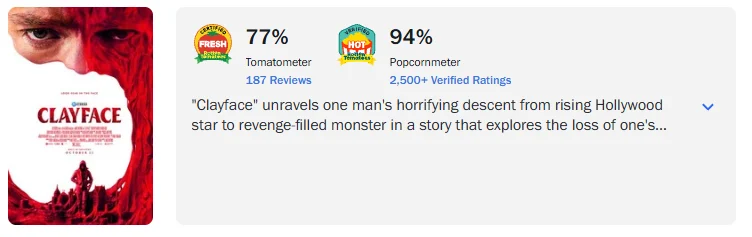
Horror films can behave differently from broad superhero releases, so comparisons across genres have limits. Still, a 57% decline paired with continued weekday earnings gives Clayface a useful base as it moves beyond its opening. Its A- CinemaScore suggests that audiences who have seen it are responding well, while critical notices are more divided. Rotten Tomatoes lists the film as Certified Fresh at 75% from 83 reviews; its Metacritic score is 59.
Some reviewers have singled out Tom Rhys Harries’ performance and the film’s body horror. Others have found the movie less memorable. That split makes the audience grade worth watching alongside the broader review picture: the film appears to be connecting with many ticket buyers, even as critical enthusiasm varies.
A horror story at a comparatively contained cost
Harries plays Matt Hagen, a rising movie star whose face is disfigured by a local mob boss. Hoping to restore his appearance, Matt volunteers for an experimental procedure. It transforms his body into living clay and gradually erodes his sanity. Naomi Ackie plays Dr. Caitlyn Corr, a fringe scientist and Matt’s love interest; Max Minghella appears as Gotham City police detective John Borrelli. David Dencik and Eddie Marsan are also in the cast.
The reported production budget was $44 million, excluding marketing. That is substantially below the reported $225 million cost of Superman and the reported $170 million to $186 million budget for Supergirl. The difference changes what success might look like: Clayface doesn’t need to match a major superhero release’s opening scale to become a useful result for the studio.
Matt Reeves, Lynn Harris, James Gunn and Peter Safran produced the film. Warner Bros. first scheduled it for September, then shifted its release to October to align with the Halloween season. The move placed the body horror story in a period when the genre has a natural audience, though release timing alone can’t account for its reception.
The theatrical target is still ahead
Clayface earned about $43 million worldwide in its opening weekend, including roughly $19 million internationally, and had passed $61.8 million worldwide by the end of its first full week. Several outlets estimate that it would need about $110 million worldwide to break even, using the commonly cited rule of thumb that a film must earn roughly 2.5 times its production budget. That estimate is not a studio-confirmed threshold, and the actual financial picture can depend on factors beyond the box office total.
The domestic projection and the estimated worldwide break-even figure leave a clear question for the rest of the run: can steady audience interest carry the film to a total that makes its relatively restrained production cost count? Its current holds make that prospect plausible, but the outcome remains open.
For DC, the film’s performance may offer a practical signal about genre range. A contained horror production can create room for a different kind of story and a distinct audience experience, while keeping production spending below the scale of the studio’s biggest releases. Clayface still has to finish its theatrical run before that approach can be judged, but its second-week pattern gives the studio something concrete to track: sustained interest after opening weekend.