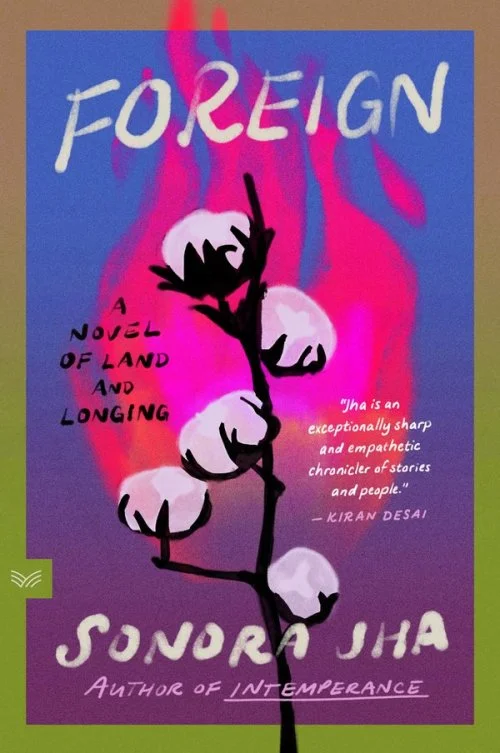
Sonora Jha’s *Foreign* Finds Its Heart in the Lives of Rural Indian Farmers
Story by Malavika Praseed · 763 readers
Sonora Jha’s debut novel centers farmers’ struggles with empathy, though its family story and supporting characters feel less fully developed.
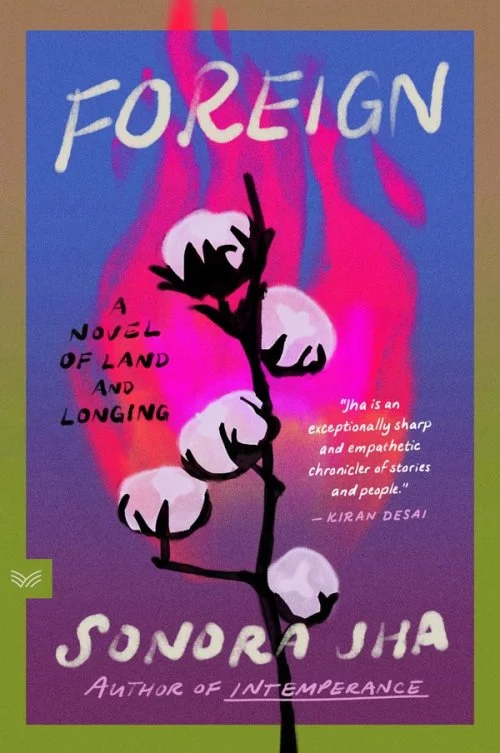
Sonora Jha’s Foreign is most affecting when it turns its attention to the people living through rural India’s Farmer’s Crisis. First published in India in 2013 and now receiving a North American release, the novel gives farmers space to express their fears, loyalties and daily pressures. Those chapters carry a tenderness and depth that the book’s other storylines don’t consistently reach. The result is an earnest debut with a strong center and some noticeable imbalance around it.
The book’s timing gives its subject renewed resonance. The crisis, which began in the 1990s, followed years of failed crops and economic distress and led numerous farmers to die by suicide. The source of that suffering remains present in India amid climate change, while farmers in the American Plains regions face crises of their own. Jha’s novel approaches the subject through particular lives rather than broad explanation, and its most compelling scenes emerge from that close attention.
A family arrives in the farming village
Katya, an Indian emigrant, is celebrating the launch of her book with her white fiancé when news from her ancestral home abruptly changes her plans: her teenage son, Kabir, has left his grandparents’ house and disappeared. She follows him to a remote village in Maharashtra, where he has found his biological father, Ammar. He works as an activist for the farming community, and Kabir is eager to understand his family history and know the father he has not grown up with.
Katya’s reasons for coming are more complicated. She resents Ammar for leaving when their family was just beginning, and she fears that her son will encounter the same abandonment and disappointment she associates with him. But Kabir settles quickly into village life. He grows close to the farming couple Bajirao and Gayatri-bai Andhale, whose household becomes a second anchor for the story. As their lives intersect, Jha brings the family’s personal questions into contact with the broader pressures facing the farmers.
The novel uses third-person narration and shifts among characters’ perspectives. Katya initially gives readers an outsider’s entry into a world she has left behind; she is the “foreigner” of the title. Yet Bajirao and Gayatri-bai’s chapters carry much of the book’s emotional weight. Their struggles are both intimate and material: they contend with despair while making arrangements for their daughter’s marriage, and they try to sustain their family under conditions that can feel increasingly precarious.
Gayatri-bai’s story holds particular complexity. She is a matriarch whose strength exists alongside vulnerability, not in place of it. Bajirao, too, faces more than financial strain; his distress reaches into questions about his future and his sense of himself. Their attachment to each other and their family gives the narrative momentum. Through them, the farmers’ crisis becomes more than a setting: it shapes the choices and relationships that make the novel matter.
Where the story loses focus
Jha’s decision to center farmers rather than keep Katya’s perspective in the foreground is well suited to the novel’s subject. The difficulty is that Foreign continues to ask readers to follow both stories closely. Katya and Kabir introduce the family conflict, but both recede as the village characters’ experiences take over. That shift can feel meaningful, yet the book’s several strands don’t always receive equal development.
Katya’s worry as a parent is easy to understand, and her growing affection for Bajirao and Gayatri-bai makes sense within the story. Her conversations with Kabir, however, begin to feel repetitive. Her fiancé, Alec, is another thinly drawn presence. Katya occasionally refers to her love for him as her feelings for Ammar intensify, but Alec has little impact on what she decides. The romantic tension might have been just as legible without a largely absent partner waiting elsewhere.
Kabir’s portrayal raises a related concern. The review finds his compassion for the farmers so expansive that he sometimes seems more like an ideal than a fully realized teenager. His behavior toward Katya offers some friction, but it doesn’t entirely offset the impression of a child defined by exceptional empathy. The result is a less convincing family relationship than the novel’s strongest chapters provide.
The comparison with Jha’s later work makes this unevenness easier to see. Her acclaimed novel The Laughter came a decade after Foreign, and the reviewer also points to Intemperance, where the mother and son feel more fully formed. Their older ages may account for some of that difference, but the reviewer also suggests that Jha gives them more room to develop. In Foreign, attention spread across many characters leaves some of them with less depth.
An early novel with lasting strengths
These limitations don’t erase what the book achieves. Foreign is a complete story, and its strongest work lies in treating the farmers as people with distinct perspectives, relationships and pain. Readers who value fiction that places social hardship within family life may find its most powerful passages in Bajirao and Gayatri-bai’s chapters. Those looking for an evenly balanced family drama may find Katya and Kabir’s parts less satisfying.
The reviewer’s judgment is measured: Jha’s debut shows both the care and the growing pains of an early novel. More than ten years after its first publication in India, Foreign offers a chance to see how a writer’s handling of character and narrative focus developed over time. Its clearest achievement remains the attentive portrait of farmers under pressure, and that portrait gives the novel a reason to be read now.
FICTION
Foreign
By Sonora Jha
HarperVia
Published on October 13, 2026