Yiyun Li on John Field, Percherette and the Hope Behind *Music Against the Night*
Story by Stephen Patrick Bell · 779 readers
Yiyun Li discusses the musical world behind her new novel, its prodigious young artists and the hope Percherette finds in making music.

For Yiyun Li, the story of John Field and Percherette begins with a question history left unanswered: how did a young woman from Pondicherry make her way to Moscow? In Music Against the Night, the first book in Li’s Nocturne Trilogy, that gap becomes room for a life. The novel follows two musical prodigies across continents and childhood, framing their story with their deaths and the difficult marriage they leave behind.
Field was an Irish virtuoso who became known in Moscow as “The Englishman.” He invented the nocturne, a form later popularized by Chopin. Percherette, an orphan of mixed descent born in French Pondicherry, is a gifted musician too, but her ambitions reach beyond music. Li’s novel gives both characters the time to grow into their talents and troubles, with a narrator who slips between past, present and future in parenthetical asides.
That structure reflects the book’s central tension: a life can be shaped by an ending without being reduced to it. Li’s first novel since her Pulitzer Prize-winning memoir Things in Nature Merely Grow, the book carries questions of grief and endurance into the lives of historical figures. In a conversation with Stephen Patrick Bell, Li discussed the novel’s narrator, the uncertain record around Percherette, the business of music and the persistence required to make art.

A narrator with room to roam
Stephen Patrick Bell: The narrator feels like the novel’s backbone. Those parenthetical passages bring the past and future close to the immediate scene without interrupting it. Will that voice carry through the trilogy?
Yiyun Li: Yes. It’s an omniscient third-person narrator, and I suppose it sounds like me. My editor once told me the narrator was the most important character in the draft. I realized she was right: the voice matters as much as John and Percherette, and it will carry through the books.
That kind of omniscient narrator feels natural to me because I read older novels. Dickens has a third-person voice that is unmistakably his, especially in Bleak House. Tolstoy’s narrator also knows a great deal, though mine is more mischievous. Contemporary writers use that voice less often, but I enjoy its freedom.
Bell: The narrator feels like a co-conspirator, stepping aside to give us context. Your acknowledgements mention Edmund White, and you say you found Field while reading Tolstoy together.
Li: We were reading Tolstoy’s three-volume autobiography. Early in it, Tolstoy recalls listening to his mother play John Field on the piano. She died before Tolstoy turned two, and he wrote, “Field was my mother’s master.” I hadn’t heard of Field, so I looked him up and told Edmund I might write a book about him. Even Edmund wondered whether Field was English. He was Irish, although people called him “The Englishman” during his adult life in Moscow.
Making a life from a biographical gap
Bell: What did the research tell you about Field?
Li: I didn’t decide immediately to make him the subject. I found a very thin biography, much of it devoted to musical scores and composition, with only a short sketch of his life. Percherette received even less space—perhaps a page or two. The biographer said that nobody knew how a young woman from Pondicherry came to live in Moscow. When a record says “nobody knew,” a novelist has somewhere to begin.
I started wondering about both journeys: Field from Dublin to Moscow, and Percherette from Pondicherry to Moscow, perhaps by way of France. That was when I decided they should share the novel. Their paths give the story its geography, while their music gives it a way to follow how they change.
Bell: Did any particular details from the biography make it into the novel?
Li: Two details struck me as funny. One contemporary described Percherette as so flirtatious that she would flirt with a hat set on a walking stick. That’s a peculiar thing to say about a young woman, and I wanted to keep it in mind.
The other story concerns Field’s return to London in 1832. He was middle-aged then and told English women that he married his wife because she couldn’t pay for his lessons, so he took her up to get something from teaching her. Those are the biographical fragments I had. We know the broad movements: Field went from Dublin to Bath, then London, and eventually Moscow. For Percherette’s passage from Pondicherry, we have to make an assumption about her route. The rest belongs to the novel.
Field became a respected musician, but later fame attached more firmly to Chopin, who popularized the form Field had created. That imbalance is part of the story: the historical record preserves some names vividly and leaves others at its edges.
Three books, three stages of a life
Bell: Chopin is present in the larger story of Field’s music, but this first volume keeps its attention on John and Percherette as children. How did you shape the trilogy?
Li: I thought about the familiar divisions used in autobiographies: childhood, youth and adulthood. You can’t tell the story of two children without knowing who they become, though. We know that Field and Percherette’s marriage will fail, and we know that Field ends up broken and hopeless. That knowledge lets us see their earlier years differently. Before hopelessness, there’s hope. We need to understand the end, but we also need to spend time with them while they’re still becoming themselves.
The first book begins with their deaths, then looks backward. I wanted to stay with their childhoods because they are both prodigies, and because we need to grow up with them. Percherette interests me especially: she is a musical prodigy, but she is also a prodigy at living. She wants things beyond a career in music and makes her own way toward them.
The second book will follow their marriage as they develop into mature artists, and the strain that puts on their relationship. The third will bring Field back to London. He returned for a tour of the continent, but the tour failed, and by then Chopin had become the name everyone was watching.
There were many musicians at work in that period, though the names that endure most widely are Mozart, Beethoven, Chopin and Liszt. Clementi is another figure I find fascinating. He became a manufacturer. These artists were creating, touring and making music into a business. I’m interested in the people who built that world, not just in the figures who reached its summit.
When music became a business
Bell: Do you see a connection between the musicians and businesses in Field’s world and the people who make books today?
Li: I don’t think of the novel as simply a historical exercise. I’m interested in what happens when music changes from something associated with the church and aristocratic courts into a public art and a business. Musicians had once depended on religious institutions or powerful patrons. Around Field’s time, people began attending public concerts, and music publishers and manufacturers became part of the system.
That change made music more accessible. In Jane Austen’s novels, characters in the countryside can buy a pianoforte and play songs at home. Behind those performances are people writing the songs, printing them and making the instruments. The whole system interests me.
Publishing still has artists and businesspeople, and the people making art still struggle. The systems have changed, but the relationship between creative work and the people who support and distribute it feels enduring.
Clementi understood that he might never stand at the top of the musical pyramid. Mozart, Haydn and Beethoven were there, in his view, but he saw that the people forming the base mattered too. He helped make the pyramid possible. I gave him that thought in the novel, and it matters to me: an artist’s importance doesn’t depend on being the most celebrated name.
What a prodigy is asked to become
Bell: Percherette seems to bring a different kind of energy from John. He is driven toward perfection, while she wants music alongside other things. What did that difference mean to you?
Li: I didn’t set out to write a perfect novel. Percherette brings life with her wherever she goes. She wants many things, and music is only one of them. That makes her easier for me to write, in some ways.
John’s path is more constrained. The adults around him decide he will become a musician. He can’t read or do arithmetic; music is what he has been prepared to do. His gift is both a blessing and a burden. He represents artists whose lives have been organized around talent before they’re old enough to choose what that means.
Other young musicians were coming up too. George Pinto, for example, is a character I’m fond of. People said cruel things about him because he was gay, and some claimed he would be a great musician if he were not. But his emotional life was part of what made him the musician he was. These children had to be themselves while finding a way to express themselves through art. That is a difficult position.
There is something fatalistic in the path laid out for prodigies. Mozart died young; Chopin did not live long. Percherette’s situation is different because she doesn’t have to pursue music. She chooses it and keeps trying to find a place in it. I find that choice compelling.
Taking children seriously
Bell: You make children’s minds feel distinct and readable. How do you enter a child’s perspective without making it feel artificial?
Li: While I was writing, another novelist said I didn’t need to spend time on the children’s lives. I could give them a few important moments and start when they were adults. I found that insulting to the characters, and to children more generally. It suggests that childhood is only preparation for the life that counts.
Children live with the same seriousness, confusion and difficulty as adults. They can feel and observe a great deal, but they don’t yet have the language to explain what’s happening. Writing about children means giving them words without making those words sound too grown-up.
When you’re small, the world can seem as if it’s failing to make sense to you. Early in the novel, Percherette doesn’t think she’s the one who can’t understand; she thinks the world hasn’t yet found a way to explain itself. That difference in perspective is what I’m trying to honor. Children see the world differently, and they deserve room on the page to feel and think in their own terms.
John’s younger sister, Grace Anne, is precocious and sharp, but she is still a child. When the family leaves Dublin, she asks, “Why are people so afraid to die? Growing up is more terrible than dying.” An adult might not be able to say that with the same force. Children notice things we’ve forgotten how to see. We shouldn’t look down on them or treat them as unfinished adults.
Writing alongside grief
Bell: Things in Nature Merely Grow and this novel share an interest in presence and in the way people experience time. How did writing the memoir shape the novel?
Li: I began the novel in early 2023. About a year into writing it, James died. I finished a draft before I began writing Things in Nature Merely Grow, then returned to the novel to revise it. Some of what I learned while writing the memoir came back to the fiction. The books are intertwined, but they work differently: in the novel, I think through the characters rather than through my own life.
Bell: When do you feel most present? John has those five hours of rehearsal.
Li: That sounds like me too. Five hours of writing is something. You sit down and work. It might not be good work, but it exists; that’s better than nothing. When you write a book, you live with the characters for years. I feel close to John and Percherette, and I’ll live with them through two more books.
Percherette has also sustained me during difficult moments. After her companion dies, she says she will aspire to live forever—not literally, but because she wants to live. That aspiration has helped me too.
Music as an argument with finality
Bell: Death is present from the beginning, and births are often paired with losses. Does the book treat death as an adversary or as a constant companion?
Li: Field’s biography mentions that his parents had other children who died. Sometimes parents lost a baby and reused the name. John, Robert and Grace were all names given again. Parents die; people die. It’s inevitable.
Percherette’s response matters to me. She lives a long life and sees people die, but she says that her music is an argument with finality. As long as she’s alive, she will keep arguing with that darkness. That’s what I hear in the title, Music Against the Night.
When we think of nocturnes now, Chopin’s often come to mind: beautiful and calm. But night can be disturbing too. Field’s nocturnes have beauty, but there are unsettling moments in them. The music keeps speaking against death and all the losses that gather around a life.
The work of replacing a placeholder
Bell: You thanked Bridgid Hughes for a “placeholder.” What did you mean?
Li: She’s a close friend who has been with me through difficult periods. Sometimes she holds a thought for me: I say something unfinished or not very sensible, and she keeps it until I’m ready to work it out.
There’s a writing meaning too. She has edited my work, and sometimes she’ll call a line a placeholder. The thought is there, but the language isn’t good enough yet. Writing itself is a placeholder. You can’t aim for perfection; you try to find a better version than the one you had yesterday.
Bell: John’s teacher tells him the music he composes and plays will never equal the music he hears in his head. That feels familiar to a writer.
Li: We all feel that way. But you still have to reach for what you hear.
Bell: Maybe the point is in the reaching. That feels like Percherette.
Li: I love that you love Percherette. She has our spirit.
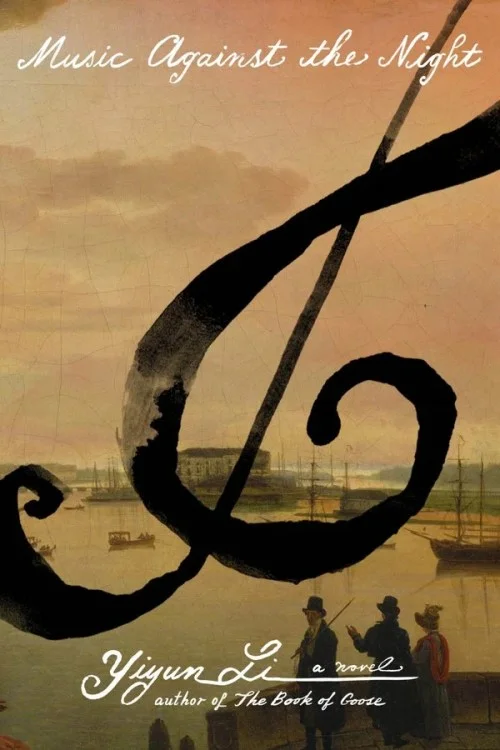
Fiction
By Yiyun Li
Farrar, Straus and Giroux
Published on October 13, 2026