Why Sapphic Fiction Readers Draw a Firm Line at AI-Written Books
Story by Christopher Williams · 622 readers
Sapphic fiction readers strongly favor human-created books, reflecting concerns about AI’s effects on authors and other creative workers.
What readers’ AI objections tell us
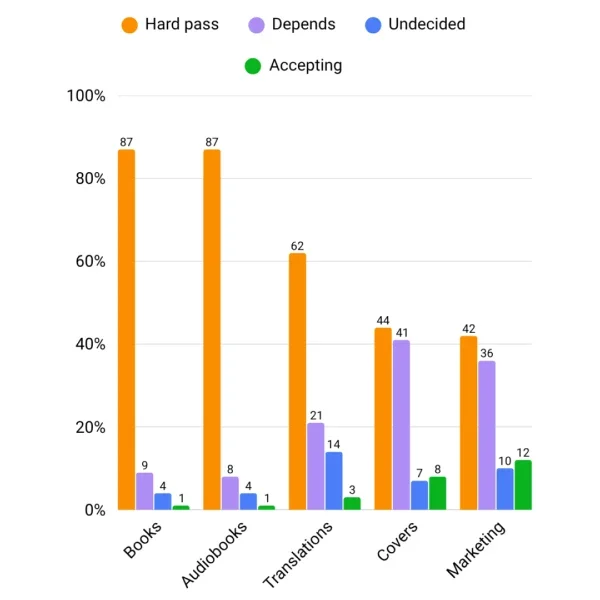
The clearest finding in this survey is how firmly sapphic fiction readers draw the line at AI writing and narration. Covers, translations and promotional material get more mixed responses, but that difference shouldn’t be mistaken for broad approval. Most readers still favor work made by people.
That distinction matters because authors in this small market are already under financial pressure. In a separate author survey, 80% said they make little or no money from writing; more than half reported lower writing income over the past year, and nearly a third described the decline as significant. Authors named the flood of AI books as their biggest challenge. A 2026 study found that monthly new releases have tripled since ChatGPT launched, while AI tools can produce books at extraordinary speed. The resulting competition for search results, recommendations, bestseller lists, advertising and social media attention leaves human authors spending more time marketing and less time writing.
The effects reach beyond authors. When income falls, writers have less money to invest in audiobooks and translations, and generative AI can displace narrators, translators, editors and cover artists directly. New authors face another problem: readers who worry a book might be AI-generated may hesitate to try someone they don’t know. The previous report on readers’ buying and reading habits is available in part one.
Generative AI and assistive tools aren’t the same
Before looking at the reader responses, it helps to be precise about what “AI” means here. Generative AI produces new text, images, audio or video from prompts. Its models learn patterns from large datasets, including books and artwork taken from piracy sites without creators’ permission or compensation. Assistive tools, by contrast, work on material people have made: spellcheckers, manuscript analysis, audio noise reduction and image editing are familiar examples.
The boundary can blur. An author might draft a book and then use AI to rewrite it so extensively that the original voice disappears; calling that assistance is debatable. Translation is another case often described as assistive, but Amazon KDP classifies AI translations as generative. Tools such as Kindle Translate can automate the process without a human translator or editor. Literary translation also involves choices about humor, wordplay, cultural context and emotional effect; replacing words one by one rarely preserves those things.
So when creatives object to AI in this survey, they mean systems that replace human work and can flood a small market with cheap content. The report focuses on that kind of generative AI. Its results shouldn’t be used to normalize those tools, or to accuse individual authors without solid evidence. Both risks can hurt the sapphic book community.
Readers draw a hard line at AI books
Asked whether they would read a book they knew or suspected was AI-generated, 87% chose “hard pass.” Another 5% might consider one if the story sounded compelling, 4% would read it only if free or included in Kindle Unlimited, and 4% were undecided. Just 1% said they didn’t mind. That’s a striking level of resistance: only 9% named circumstances in which they might make an exception.
Age shaped the response. The share choosing “hard pass” fell from 97% among readers under 25 to 80% among those 65 and older. Readers in predominantly English-speaking and other countries were equally likely to reject AI-written books, at 87% in each group. Country-level responses varied: rejection was highest in Brazil (93%), followed by Canada (91%) and the Netherlands (90%); it stood at 86% in both the US and UK, 85% in France and Australia, and 84% in Germany.
Covers get more conditional responses
An AI-generated cover is less likely to end a reader’s interest outright, but it still raises doubts. Forty-four percent said they wouldn’t read a book with an AI cover. Another 22% might read one from an author they trust not to use AI for the writing; 13% would make an exception for an appealing story, and 6% if the book were free or included in a subscription. Seven percent were undecided, while 8% said they didn’t mind AI covers.
The author-trust response is telling. For some readers, an AI cover may signal that the book itself could be AI-generated, so trust in the writer becomes part of the decision. Overall, 41% described circumstances in which they might read a book with an AI cover, but that conditional openness is not the same as acceptance.
Again, younger readers were more likely to reject the cover: “hard pass” responses ranged from 73% among those under 25 to 27% among readers aged 55 and older. Responses also differed by country. France led at 59%, followed by Brazil at 55% and Canada at 52%. The figures were 44% in the US, 41% in Australia, 39% in the UK, 38% in Germany and 37% in the Netherlands. Brazil and Canada appear among the stronger opponents across both books and covers, though country comparisons don’t explain why attitudes differ.
What the wider survey finds
The same broad pattern runs through the remaining results: 87% of audiobook listeners reject AI narration, and only 1% don’t mind it. For AI translations, 62% reject them outright and 3% say they don’t mind. Promotional images and videos draw responses similar to covers: 42% would avoid an author who regularly uses AI-generated promotional material, while 12% wouldn’t mind.
Readers from non-English-speaking countries were more likely to reject AI translations, even though their views on AI-written books matched those of readers in predominantly English-speaking countries. Across countries, respondents in France, Brazil and Canada generally rejected AI content more often; those in Germany, the UK and the US tended to be more accepting. Younger readers were more resistant across formats.
Readers say they’re somewhat confident about spotting AI, especially when its use is obvious. Twenty-eight percent felt very confident identifying AI covers, compared with 14% for AI-written books. Yet more readers also lacked confidence about covers: 32% said they were not very or not at all confident, versus 25% for books. Younger respondents tended to feel more confident overall. Those under 35 were more confident about recognizing covers than books; respondents aged 35–44 were about equally confident in both, while those 55 and older trusted themselves more to identify AI-written books. France, Brazil and Germany had the most confident respondents, and Australia the least.
Readers most often named continuity errors, repetition and an implausibly fast publishing pace as signs of AI. Those patterns can be suspicious, but they aren’t proof: weak writing and poor editing can produce similar problems in human-written books. The clearest evidence is an AI prompt left in the text or a platform label such as “Virtual Voice” or “Kindle Translate.” An unusually high release rate can raise questions, but it still doesn’t settle them.
My advice is to judge the writing rather than turn readers into AI detectives. Strong writing is easier to recognize than AI use, and it’s unlikely to be generated. Support authors by reviewing books you enjoy, and review disappointing books too; describe what affected your reading instead of making an unsupported accusation about how it was made.
For the author-side figures and market context, see the 2026 sapphic fiction author survey.