Janasha Prabhu on Queer Desire, Family and Small-Town Suspicion in Monster in the Mirror
Story by Devi Bhaduri · 606 readers
Janasha Prabhu discusses the inspirations, family tensions and queer relationships behind her thriller Monster in the Mirror.
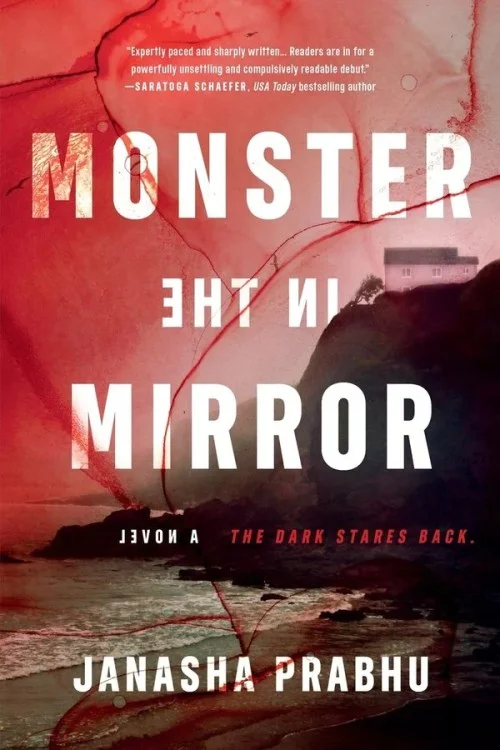
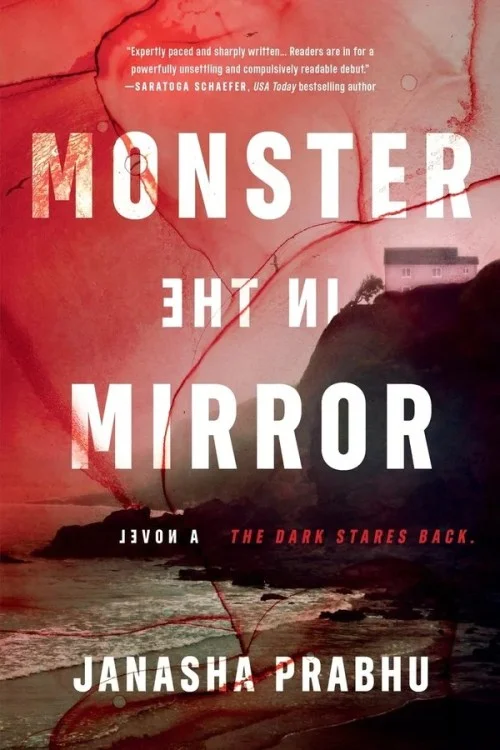
Janasha Prabhu’s debut thriller, Monster in the Mirror, puts the weight of a notorious killer’s legacy on the people left to live with it. Jiah Rai is known in her small seaside town as the niece of the Doppelganger Killer, who posed victims to face their reflections. When Jiah is found holding her dead girlfriend’s body at the foot of a cliff, suspicion settles on her. Then another victim is found in a pose matching her uncle’s signature, and Jiah faces the possibility that someone is recreating his crimes.
The novel also follows Jiah’s relationships with her family and other women, while asking what it means to be treated as an outsider in a town that prizes its own picture-perfect image. In conversation with Devi Bhaduri, Prabhu discusses writing female anger, queer desire, the influence of her own experiences, and why she chose to keep the killer out of the story’s spotlight.
A thriller shaped by anger and empathy
Devi Bhaduri: Congratulations on your debut. When did you first want to write, and what drew you to this particular story?
Janasha Prabhu: I’ve wanted to write for as long as I can remember. My parents encouraged my sisters and me to read so enthusiastically that we’d sometimes follow the wrong couple around the grocery store because we were absorbed in our books. By eleven or twelve, I knew I wanted to write stories of my own.
I’ve worked on Monster in the Mirror for about eight years. My love of thrillers started the idea, and as I grew older I wanted to write a strong woman who would fight for the people she loves. Female anger runs through the book. I think that anger has always been there, even if it’s becoming more visible now.
Bhaduri: Jiah is a serial killer’s niece, and then a copycat appears. Did you base her uncle on real or fictional killers?
Prabhu: I didn’t use a particular real or fictional killer as a model. Some readers may expect the book to focus closely on the uncle, but I wanted to take the story in the other direction. I’ve been fascinated by real cold cases, too, yet the way they’re covered can leave victims in the background while the killers become infamous. I didn’t want the victims to turn into statistics or the killer to command the story.
Growing up as an outsider in Dumont
Bhaduri: Dumont is a small New York town with little ethnic diversity and an openly hostile attitude toward queer people. Jiah is a queer, biracial woman, and she sees through the town’s charming appearance to the prejudice underneath. Have you experienced that kind of outsider status yourself?
Prabhu: Yes. I’ve encountered prejudice throughout my life, as have my sisters and my father, who immigrated to the United States as a young adult. I grew up in a smaller town with a mostly white population, and I’m queer and biracial. Some of what Jiah experiences comes from my own life.
I wanted those moments on the page in the hope that readers with similar experiences might feel a connection. When I was a young reader, I didn’t find much of that kind of relatability in the books I read.
Bhaduri: Jiah is protective of her younger sister, Lila, but keeps her at a distance as danger gathers. Lila is left to piece together what’s happening, sometimes through other people. How do you understand her reaction to Jiah?
Prabhu: Lila feels shut out, so she’s frustrated and worried. She learns things about Jiah from other people, and Jiah doesn’t let her get close. I’m very close to my own sisters, so it’s easy to imagine how I’d feel if one of them behaved like Jiah. There’s anger, but it comes from love. Sisters want to protect each other, whether they’re older or younger.
Letting Jiah be complicated
Bhaduri: Jiah sometimes feels a darker side stirring in her, and even a casual image—prosciutto in the fridge “as thin and soft as eyelids”—can feel unsettling. Do you think she has inherited something from her uncle?
Prabhu: I thought about two things. Women are often expected to be gentle and soft. Those qualities are fine, but women should also be allowed the full range of emotions, including darker ones. And Jiah struggles with anxiety. I have anxiety too, and I know unwanted thoughts can show up. I don’t think her darker thoughts point to an inherited killer gene. To me, they suggest that any person can be capable of violence.
Bhaduri: Jiah is comfortable pursuing her desire, though she sometimes uses sex to avoid other feelings. What was it like to write her relationships, including the unhealthy ones?
Prabhu: Writing them was fun, and sometimes difficult because there’s toxicity in some of those relationships. Popular media doesn’t show many toxic queer relationships, but I think it matters to acknowledge that they exist. I also loved writing healthier relationships and a woman who’s direct about wanting sex. People’s sex drives differ, but I dislike the idea that women have less desire than men. That simply isn’t true.
Writing without an outline—and what comes next
Bhaduri: The book has turns that are hard to anticipate. Did you plan its structure in advance or discover the story as you went?
Prabhu: I’m not good at outlining. With this book, I wanted to be surprised by what happened next, so I let the story unfold. It felt wonderful when everything finally came together.
Bhaduri: Which writers and books have inspired you?
Prabhu: I’ve taken inspiration from Carmen Maria Machado, Chelsea G. Summers, Layne Fargo, T. Kingfisher, Oyinkan Braithwaite and C. J. Leede, among many others. As a kid, I devoured R. L. Stine’s Goosebumps and Fear Street books. I became fascinated with Edgar Allan Poe after reading “The Tell-Tale Heart” in high school. The advice “write what you know” may sound clichéd, but it’s been the most helpful to me.
Bhaduri: What are you working on now?
Prabhu: I’m writing a second standalone novel that moves further into horror while retaining some thriller elements. It explores food, girlhood, queerness and assimilation, with dark comedy mixed in. I’m excited to share more soon.
About the book
Fiction
Monster in the Mirror
By Janasha Prabhu
Sourcebooks Landmark
Published October 20, 2026