LeeAnn Dominick’s Trick or Treat Introduces Halloween Through Flaps and Finds
Story by jilljemmett · 706 readers
LeeAnn Dominick’s Trick or Treat pairs Halloween costumes with lift-the-flap finds and facts for young children exploring the holiday.

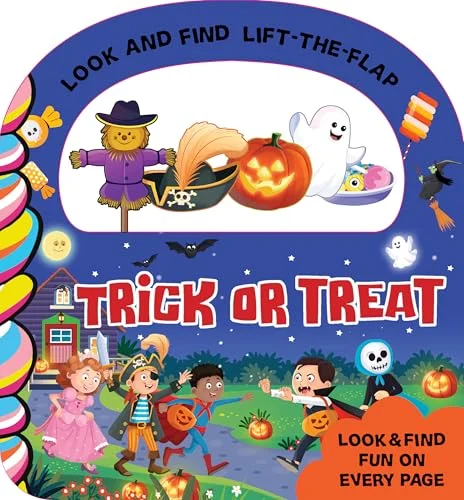
For young children meeting Halloween for the first time, LeeAnn Dominick’s Trick or Treat offers a simple way into the holiday: look at costumes, search each page for an object and lift a flap to discover more. This board book from Taffy Tales is built around shared looking and small discoveries, making it a natural choice for a grown-up to read alongside a curious toddler. Rather than relying on a plot to carry the experience, it gives the child a task on each page. That distinction suits the age group: attention can move between pictures, prompts and conversation without requiring a young reader to remember what happened several pages earlier.
A first look at Halloween
The book’s central subject is children dressing up for Halloween. Each page features different costumes, giving young readers plenty to observe and talk about. A child might point to a detail that catches their attention, name what they see or compare one outfit with another. Those exchanges can make a shared read feel personal, since the adult can follow the child’s interests instead of steering every page toward a fixed interpretation. That visual focus gives the book room for conversation even before a child can follow a longer story.
Lift-the-flap details add an activity to that looking. The flaps either point readers toward an object to find on the page or share a fun fact related to it. The two kinds of reveal offer a straightforward rhythm: search, lift, and see what’s there. A caregiver can help with the hunt, let the child lead, or pause to talk about the fact. The repeated pattern also gives a child a chance to anticipate what comes next, even when the contents of each reveal vary. That makes the book easy to revisit at a child’s pace.
The review describes Trick or Treat as a good introduction to Halloween. That recommendation fits the book’s format and subject: it presents costumes and holiday details in a compact, hands-on package, without asking a young reader to keep track of a complicated plot. For families who want a seasonal book to share with a child, the combination of bright visual browsing and flap-based play gives the reading session a clear focus. This is more significant than it looks: a first holiday book can make a new subject approachable through repeated, low-pressure interaction rather than explanation alone.
Made for reading together
Board books are designed for very young readers, and this one’s interactive premise gives adults a useful role beyond reading words aloud. The search prompts invite a caregiver to ask what the child can spot, while the flaps create moments of anticipation. Children who enjoy pointing, matching and uncovering hidden details may find the activity as engaging as the costumes themselves. The adult’s part can stay simple: wait, listen to the child’s answer, and follow up with a question when one comes naturally.
The format also suits short, repeatable reading sessions. A family can explore a single page, continue through the book, or return to a favorite find. There’s no need to turn the experience into a lesson: the objects and facts give a natural opening for noticing and talking, while the costumes keep the focus on the holiday. Here's the thing: a book that welcomes interruption can be more useful at this age than one that depends on uninterrupted attention. The reviewer’s description suggests an accessible introduction rather than an in-depth account of Halloween traditions.
That distinction helps set expectations. The available review doesn’t name the objects hidden beneath the flaps, describe the facts in detail, or outline the individual costumes. It does establish the book’s main appeal: a child can enjoy looking through the pages while taking part in a simple search. Readers seeking a detailed preview of the artwork or the specific facts will need to consult the book itself. (And this is the part most people overlook: the review can speak to the reading format, but it can’t confirm how varied or surprising the individual reveals are.)
What the format offers—and what it leaves open
A look-and-find structure gives a young reader a clear reason to stay with a page: there’s something to notice and something to uncover. That can support shared attention, as child and caregiver look at the same image and talk about what they see. It also allows children to participate before they’re ready to read independently. Small discoveries. A manageable invitation to join in.
And yet, the format’s success depends on details that aren’t described in the review, including how clearly the objects are pictured and how sturdy the flaps feel in use. Those questions matter in a board book, where handling is part of the experience. The source supports a positive recommendation for the concept and its suitability as an introduction, but it doesn’t offer enough detail to assess the durability or difficulty of the search prompts. If you're choosing a book for a child who likes to handle pages independently, you’ll want to look at the physical book before deciding.
Book details
Trick or Treat is a board book by LeeAnn Dominick, published by Taffy Tales. The listed release date is August 18, 2026. The reviewer, Jill Jemmmett, awarded it five stars and praised its potential to introduce children to Halloween. Her review is based on a copy supplied by the publisher. That context helps readers understand the basis of the recommendation, while the review’s brief description leaves the book’s specific visual choices for readers to judge firsthand.
For parents and caregivers choosing a seasonal read, the appeal here is practical and clear: costumes to look at, objects to find and flaps to lift. It’s a good fit for young children who enjoy taking an active part in a shared book, and for adults looking for an uncomplicated way to bring Halloween into story time. What this means for you is a modest but useful promise: an easy starting point for conversation, with the child setting the pace. That said, the review gives little basis for judging the artwork or the quality of the individual facts.