Elise Gravel’s My Friend Fear Helps Young Readers Meet Their Feelings
Story by Unknown · 474 readers
Elise Gravel’s October 2026 picture book uses friendly monsters to help children name fear, appreciate its protective role and approach it with curiosity.

Fear can warn us about danger, yet it can also keep us from trying something new. Elise Gravel’s My Friend Fear gives that tension a child-sized form: a cast of monsters who experience fear and consider what it can do. The picture book, written and illustrated by Gravel, is scheduled for October 2026 from North Winds Press, an imprint of Scholastic Canada. It runs 40 pages and is aimed at ages 3–8.
That framing makes the book’s central idea approachable without treating fear as a feeling children ought to simply push aside. Gravel acknowledges that everyone feels afraid sometimes, and that fears take different forms. The examples named in the book include getting lost, seeing spiders and being alone. These are familiar concerns for young readers, but they also offer openings for adults to ask what a child finds worrying and what might help them feel safer.

The monsters are the book’s way into a subject that can feel difficult to discuss directly. Their reactions give children characters to observe, while the range of fears suggests that there is no single correct reason to feel scared. A child may recognize their own worry in one character, or notice that another creature is concerned about something they find manageable. That distance can make it easier to talk: the conversation can begin with what a monster feels, then turn toward what the child feels.
My Friend Fear also presents fear as having a useful purpose. It can help keep us safe. At the same time, a fear can become so powerful that it stops us from doing things. Gravel’s proposed response is curiosity: notice the fear, acknowledge it and thank it for trying to protect you. From there, the book invites children to consider whether an opportunity might help them grow.
A gentle way to discuss a complicated feeling
This approach matters because reassurance alone doesn’t always resolve a child’s worry. A young reader may need help identifying what they feel before they can talk about what to do next. The book’s sequence, as described here, makes room for both sides of the experience: fear deserves recognition, and it need not make every decision. That gives parents, caregivers and educators language for a conversation that can continue beyond the final page.

Illustration by Elise Gravel from My Friend Fear, written by Elise Gravel
Gravel has used comic monsters to make big subjects accessible in earlier books, including It's My Body! (2022), It's My Brain! (2024) and Together: A Book About Community (2025). In each case, the reviewer says, the artist brings a broad idea down to the level of how her characters react and feel. Here, that method makes fear a shared human experience, rather than a private flaw a child should be embarrassed to admit.
The illustrations support the same invitation to notice and talk. One shows a blue monster roaring at a smaller pink creature; another presents a group of colourful creatures calling out their fears. The contrast between a startling expression and the smaller characters’ responses gives children visual cues to discuss. What might the figures be feeling? What could make someone afraid? What helps when a worry arrives? The pictures offer a starting point without requiring a child to explain their own feelings immediately.
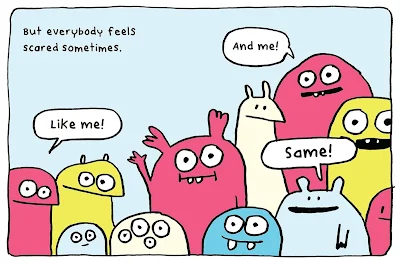 |
| Illustration by Elise Gravel from My Friend Fear, written by Elise Gravel |
The reviewer particularly appreciates the book’s attention to neuroplasticity: the brain can change, and people can change how they understand their fears. That idea gives the book’s message room to develop. A fear may feel fixed in the moment, but recognizing it and looking at it with curiosity can create another way to respond. The reviewer also finds Gravel’s innocuous monsters an engaging vehicle for helping very young children talk about an uncomfortable feeling.

Illustration by Elise Gravel from My Friend Fear, written by Elise Gravel
For families choosing a picture book about emotions, the appeal here is the balance between taking fear seriously and leaving space for change. Gravel’s monsters model a way to name worries, recognize the care behind them and consider what comes next. When My Friend Fear arrives in October 2026, its strongest use may be as a prompt for the conversations children and adults are still learning how to begin.